Custom ERP Software in Textile & Apparel: 10 + Benefits You Should Know

Updated: Aug 17

The textile and apparel industry has complex workflows. Styles, colours, sizes, seasons, fabric types, and fast‑changing demand make operations challenging from day one. Simple spreadsheets or generic software quickly reach their limits for growing businesses.
This is where custom ERP software for textile and apparel industry helps. Off‑the‑shelf solutions cover common needs, but many manufacturers need custom ERP software in textile and apparel that fits how their business actually works across planning, production, inventory, sales, and finance.
In this blog, we will outline more than ten practical benefits of custom ERP software in the textile and apparel industry, and show how the right ERP backbone can turn complexity into a clear advantage.
Table of Contents
Key Takeaways
Custom ERP fits complex textile and apparel workflows better than generic tools.
Centralized system improves visibility across production, inventory, sales, and finance.
Accurate inventory and order management reduces delays and excess stock.
Automation speeds up operations, reduces errors, and improves consistency.
Real-time data enhances customer commitments and decision-making.
Scalable ERP supports growth, analytics, and long-term efficiency.
10+ Benefits of Custom ERP Software in Textile & Apparel
Here are some of the key benefits that custom ERP software solutions brings to textile and apparel businesses, across operations, inventory, sales, finance, and analytics.
Streamlining Business Operations Across Departments
In many units, purchase, production, sales, and finance each use separate tools. Data sits in different files, and people spend time reconciling numbers.
With custom ERP for textile industry, all departments work on one system. Purchase orders, production plans, inventory updates, sales orders, and invoices move through a single platform. Merchandisers, production managers, and accountants see the same real‑time information.
This reduces manual handovers and confusion, and gives management clearer control over the whole operation.
Optimizing Inventory and Order Management
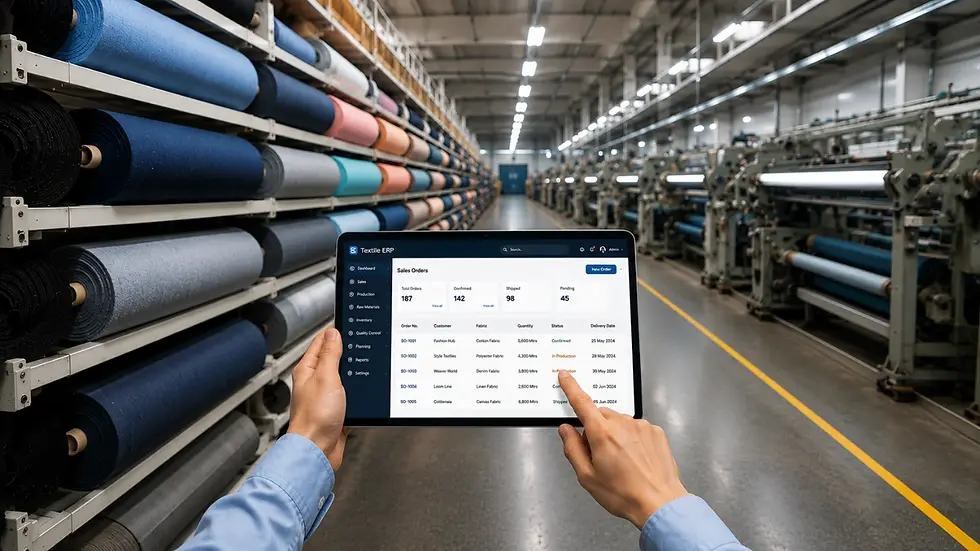
Textile and apparel inventory is complex. You must manage fabric, trims, accessories, finished garments, and multiple sizes and colours. Poor visibility leads to stockouts for popular items and dead stock for slow movers.
A focused textile and apparel ERP software gives clear control over stock and orders. You can see exact quantities by location, batch, colour, size, and style, and link them directly to sales orders and production plans.
With custom ERP software for garment industry or apparel manufacturing , you reserve stock for priority orders, reduce last‑minute substitutions, and process orders faster and more accurately.
Centralized Data and Better Visibility
Without centralized data, planning is slow and often based on partial information. Sales has one view, production another, and finance a third.
An ERP for textile manufacturers creates a single source of truth. All departments read from the same database for orders, inventory, production status, and delivery performance. Key textile ERP benefits include faster responses to customer queries, more accurate production planning, and better visibility into on‑time delivery and capacity use.
Automating Order Processing and Returns
Order processing in textile and apparel involves many checks. Capacity, fabric availability, dates, and approvals all play a role. Returns and cancellations add extra work.
Custom ERP software in textile and apparel can automate much of this flow.
Once an order is entered, the system triggers stock checks, internal approvals, and production tasks with clear steps. Returns and complaints are also logged in a structured way, so teams can track reasons, actions, and impact on future orders. This keeps order handling fast and consistent.
Enhancing Quality Control
Quality issues in fabric or garments cause rework, discounts, and unhappy customers. Paper‑based checks are hard to track and analyse.
A specialised ERP software solutions for textile industry supports quality control at each stage. You can define checkpoints for fabric inspection, in‑line garment checks, and final inspection. Inspectors record defects in the system, and managers see reports by style, machine, line, or team. Over time, this helps reduce recurring problems and improve overall quality.
Improving Customer Relationships and Experience
Buyers expect clear commitments and reliable delivery. When information is scattered, it is hard to give honest dates or quick updates.
With ERP software for apparel industry, sales teams see live production and inventory data. They can promise realistic timelines, share order status quickly, and manage changes with less confusion. Strong apparel ERP benefits include better on‑time performance, fewer disputes on quantity or quality, and a more professional customer experience.
Leveraging Cloud and Omnichannel Flexibility
Many textile and apparel businesses now sell through multiple channels and manage multiple locations. On‑premise systems often struggle to connect everyone.
Cloud‑based textile manufacturing software allows teams to access real‑time data from factories, warehouses, and retail or online channels.
The same ERP can support offline and online sales, job work, and distributed storage, with proper controls and permissions. This makes scaling and adding new channels much easier.
Reducing Machine Downtime
Machine downtime reduces capacity and disrupts delivery plans. When records are incomplete, it is hard to see patterns or plan maintenance.
An ERP for textile manufacturers can track downtime by machine, shift, and reason. It links maintenance schedules, spare parts use, and technician activity. This helps you move from reactive fixes to preventive care, reduce breakdowns, and keep production lines running more consistently.
Automating Financial Reporting

Finance teams often spend long hours matching operations data with accounts. Manual reconciliation is slow and error‑prone.
With garment manufacturing ERP software, operational transactions can automatically generate accounting entries. You gain clearer visibility into sales, costs, margins, and cash flow. The monthly closing process becomes faster, and management receives more reliable reports for planning and control.
Better Forecasting and Analytics
Demand in textile and apparel changes with seasons, trends, and buyer behaviour. Decisions based only on gut feel often lead to excess stock or missed sales.
A good textile ERP software keeps a detailed history of orders by style, colour, size, region, and customer. You can analyse what sells well, which periods are strong, and which customers are most valuable. These textile and apparel ERP advantages help improve production planning, buying decisions, and sales strategies.
Simplifying Purchasing and Vendor Management
Purchasing fabric, yarn, trims, and services from multiple vendors is complex. Without a system, tracking performance and prices is difficult.
An integrated ERP software for garment industry centralises vendor data. You can track lead times, prices, quality records, and reliability. Purchase orders link to real demand and stock levels, which reduces emergency buying and last‑minute changes. Over time, this improves vendor relationships and supports better negotiation.
Cost of Custom ERP in Textile and Apparel
The cost of custom ERP for textile industry or custom ERP for apparel business depends on scope, users, modules, and integrations. Most SMEs start with a core phase that covers inventory, production, sales, and finance, and then add advanced features later.
It is important to match ERP scope to business goals. A focused, well‑implemented system usually delivers more value than a very large project that teams struggle to use. When planned correctly, custom ERP becomes a long‑term asset rather than a one‑time expense. You May Also Read: How to Choose the Best ERP Software Development Services for Manufacturing Firms
How Palm Infotech Helps Textile and Apparel Businesses?
Palm Infotech works with textile and apparel manufacturers that want custom ERP solutions aligned with their real processes. Our team studies your workflows, identifies gaps, and designs & develop custom ERP software that fits your way of working.
We roll out the system in phases, train teams, and refine the solution based on actual usage. As you grow, we help extend the ERP with new modules and features, so it remains a strong backbone for daily operations and future expansion.
Want to see how custom ERP can work for your textile or garment unit? Reach out to us to schedule a walkthrough of real‑world use cases.
Conclusion
Textile and apparel businesses need more than generic tools to manage complex products, frequent changes, and tight margins. A well‑implemented ERP software for textile & apparel industry gives clarity, control, and confidence.
For many growing manufacturers, a custom ERP for textile industry or for apparel business delivers the best fit. It reflects real workflows, supports better decisions, and becomes a key part of long‑term growth.