How to Choose the Best ERP Software Development Services for Manufacturing Firms

Updated: Aug 17

Manufacturing businesses rely on accurate data, connected processes, and clear visibility across operations. When inventory, production, procurement, finance, and quality teams work in separate systems, delays and errors can quickly affect costs and delivery timelines.
The right custom ERP software development services for manufacturing firms can consolidate these processes into a single platform. However, an ERP is a long-term business investment. It should fit your workflows today while being flexible enough to support your future growth.
Key Takeaways
Start by identifying the operational issues your ERP development needs to solve.
Prioritize modules such as inventory, procurement, production, finance, and quality control.
Set a practical budget, timeline, and rollout plan before contacting vendors.
Choose a partner with experience in custom workflows, integrations, and data migration.
Compare proposals based on long-term value, not only the initial development cost.
Confirm post-launch support, maintenance, and system enhancement options before finalizing the partner.
Table of Contents
Benefits of Choosing the Right ERP Software Development Services
Step-by-Step Process to Choose ERP Software Development Services for Manufacturing Firms
Questions to Ask Before Hiring a Manufacturing ERP Software Development Company
How Palm Infotech Helps Manufacturing Firms With ERP Software Development
Benefits of Choosing the Right ERP Software Development Services
A well-planned ERP system does more than digitize paperwork. It gives manufacturing firms better control over operations and helps teams make informed decisions faster.
The key benefits of ERP software for manufacturing industry include:
Real-time visibility into inventory, orders, production, and finances
Better material planning and stock control
Fewer manual entries and reduced operational errors
Easier coordination between departments
More accurate production scheduling and cost tracking
Scalable processes as the business grows
Purpose-built enterprise resource planning software for manufacturing can reflect your approval flows, production methods, reporting requirements, and team roles, rather than forcing your business to adapt to a generic system.
Step-by-Step Process to Choose ERP Software Development Services Partner for Manufacturing Firms

The best decision comes from a structured evaluation, not from comparing price quotes alone. Use the following steps to find a development partner that understands both your business and the technology behind it.
Step 1: Identify Your Business Requirements
Start by mapping your current processes. Speak with people from production, procurement, warehouse, accounts, quality, and sales.
Look for recurring challenges such as:
Inventory mismatches
Delayed purchase approvals
Manual production planning
Difficulty tracking work orders
Fragmented reporting
Limited visibility into job costs
This discovery stage gives your future ERP project a clear direction.
Step 2: List the ERP Modules Your Business Needs
Not every manufacturing firm needs every ERP module on day one. List the features that will have the biggest operational impact. Your ERP software modules may need modules for:
Inventory and warehouse management
Procurement and vendor management
Production planning
Bills of materials and work orders
Quality control
Sales and order management
Finance and accounting
HR and payroll
Reporting and analytics
Prioritize the modules that solve your immediate business problems. Other capabilities can be added in later phases.
Step 3: Define Your Budget, Timeline, and Business Goals
Before speaking with vendors, establish realistic expectations. Your scope, number of users, integrations, custom features, and data volume will all influence the ERP software development cost.
Define:
The operational problem you want to solve
The processes you want to automate
A target launch timeline
Internal resources available for the project
A budget range for development and long-term maintenance
A clear brief helps an ERP software development company provide a more accurate proposal.
Step 4: Shortlist ERP Software Development Companies
Shortlist companies based on relevance, not just their online presence. Look for partners that build custom ERP systems and have a structured approach to discovery, design, development, testing, and support.
Review their website, service pages, client feedback, technical expertise, and project process. This will help you separate firms that only offer generic products from teams that provide tailored ERP software development solutions.
Step 5: Check Their Manufacturing ERP Development Experience
Manufacturing workflows are different from standard CRM or accounting software. Your partner should understand concepts such as production cycles, procurement, inventory movement, work orders, material consumption, and quality processes.
Ask the company how they approach ERP software development for manufacturing . A capable partner should ask detailed questions about your business operations before recommending a solution.
Step 6: Review Their Portfolio and Case Studies
A portfolio and case studies shows the type of systems a company has delivered. Look beyond attractive interfaces and focus on business complexity.
Check for examples involving:
Multi-role user access
Workflow automation
Inventory or marketplace management
Reporting dashboards
Third-party integrations
Secure payment or transaction systems
A strong portfolio indicates that the team can manage the technical and operational demands of your ERP project.
Check our case study on ERP development project for manufacturing vertical.
Step 7: Evaluate Their Customization Capabilities
A pre-built system may cover basic functions, but manufacturers often need workflows that match their exact operations. This is where custom ERP development Ask if the development team can customize:
Role-based dashboards
Approval workflows
Production reports
Purchase and stock rules
Alerts and notifications
Industry-specific forms and fields
The goal is to build a platform around your business, not make your team work around software limitations.
Step 8: Check Integration Support With Existing Systems
Your ERP may need to connect with accounting software, barcode systems, eCommerce platforms, logistics tools, CRM platforms, or machines and IoT systems. Ask how the provider handles APIs, third-party integrations, data synchronization, and integration testing. Reliable ERP implementation services for manufacturing should account for these connections early, not treat them as an afterthought.
Step 9: Ask About Data Migration, Security, and Compliance
Moving from spreadsheets or older software can be difficult. Your development partner should explain how they will clean, structure, validate, and migrate your existing data.
Also discuss:
User permissions
Data backup and recovery
Secure hosting
Audit trails
Access controls
Relevant industry or regional compliance needs
A secure ERP protects sensitive financial, supplier, employee, and production information.
Step 10: Understand Their Development Process
A clear process reduces surprises. Ask how the team moves from requirements to launch.
Palm Infotech follows an Agile, milestone-based process that includes discovery, UI/UX design, technical planning, development, QA and user acceptance testing, and deployment. This approach lets clients review working builds throughout the project rather than waiting until the end.
Step 11: Understand Their Communication Model
ERP projects involve many decisions. Regular communication helps prevent misunderstandings and keeps the project aligned with business needs.
Ask who will be your primary contact, how often progress will be shared, and how feedback will be managed. You should receive demos, updates, clear milestones, and timely answers during the project.
Step 12: Compare Pricing, Support, and Long-Term Value
Do not judge providers on the initial quote alone. Compare the scope behind each proposal. Consider the full custom ERP development cost with other vendors also , including:
Discovery and planning
Design and development
Integrations
Data migration
Testing
Training
Hosting
Maintenance and future enhancements
A lower quote can become expensive if it excludes core functionality or offers limited support after launch.
Step 13: Check Post-Launch Support and Maintenance Services
Your ERP will need updates as your operations, users, devices, and integrations change. Post-launch support is part of a successful implementation.
Palm Infotech provides 30 days of free post-launch support for bugs and stability issues, followed by flexible maintenance packages for updates, monitoring, and feature enhancements.
Step 14: Finalize the ERP Development Partner
Once you have reviewed the shortlisted providers, select the partner that understands how your factory operates and what you want the ERP to achieve. A reliable manufacturing ERP development partner should clearly explain the proposed scope, project schedule, technical approach, possible risks, and support available after deployment. Look for a partner that asks thoughtful questions before making promises.
You May Also Read: How Mobile Applications Are Reshaping Manufacturing Operations
5 Key Elements While Choosing the Best ERP Software Development Company for the Manufacturing Industry
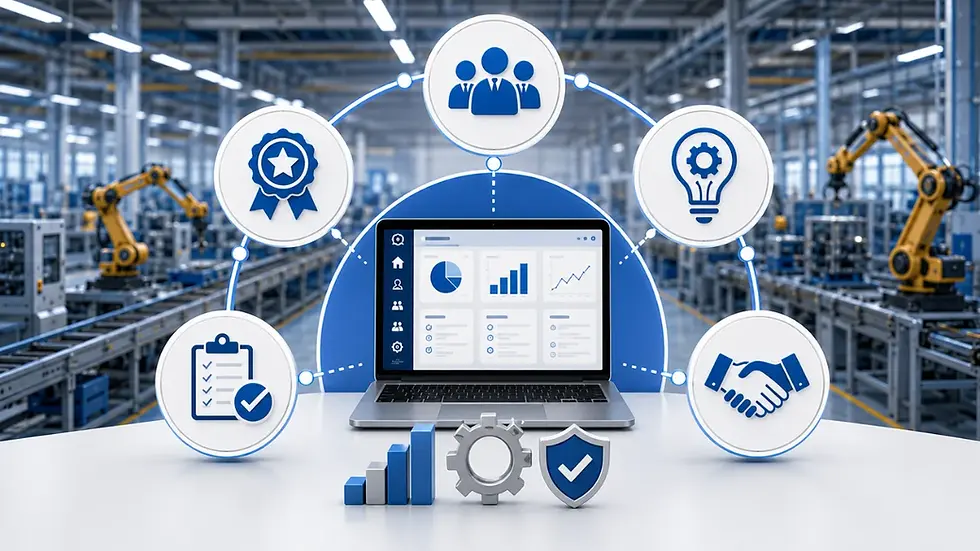
These five factors should carry the most weight in your final decision:
Manufacturing workflow understanding
Customization and integration capability
Clear project process and communication
Secure data migration and access controls
Long-term support beyond launch
Questions to Ask Before Hiring a ERP Software Development Company for Manufacturing Industry
Ask these questions during your evaluation:
Have you developed systems with inventory, production, and procurement workflows?
Can you build the ERP around our current processes?
Which modules should we launch first?
How will you integrate our existing software?
How do you manage data migration and testing?
Who owns the source code and intellectual property?
What is included in the quote?
What support will we receive after launch of the application?
How Palm Infotech Helps Manufacturing Firms With ERP Software Development
Palm Infotech offers custom software development services rather than selling white-label clones or templates. Its in-house team includes developers, UI/UX designers, quality analysts, and project managers, enabling a coordinated approach from discovery to launch.
For firms looking for manufacturing software development services, Palm Infotech can help define requirements, plan modules, build custom workflows, integrate business tools, and deliver an ERP through transparent milestone-based development. The team also supports post-launch stability and ongoing enhancement needs.
Conclusion
The best ERP software for manufacturing firms is not simply the one with the longest feature list. It is the one that focuses on the processes that slow production, create inventory issues, or make reporting difficult.
The right software development partner will turn those requirements into a practical ERP system that fits your workflows today and remains flexible as your operations expand. Ready to streamline your manufacturing operations? Contact Palm Infotech to discuss a custom ERP development solution built around your workflow.